
Isabela Island, Galápagos — The Complete Visitor Guide

Juan Magallanes, Naturalist Expert Contributor

Isabela Island is the largest of the Galápagos Islands at 4,670 km², formed by six shield volcanoes — five of which remain active. It holds more wild giant tortoises than all other islands combined, and its west coast is the only place on Earth where Galápagos penguins and flightless cormorants share the same shoreline.

The Island at a Glance

Before the specifics, a quick reference table for the facts most travelers need first.

Area

4,670 km² (1,803 mi²)

larger than all other Galápagos islands combined

Shape

Seahorse

Volcanoes

Six shield volcanoes: Ecuador

Wolf, Darwin, Alcedo, Sierra Negra, Cerro Azul (N to S

Active Volcanoes

Five active

all except Ecuador Volcano

Highest Point

Wolf Volcano

1,707 m (5,600 ft) — highest point in the Galápagos

Main Town

Puerto Villamil

Population

~1,800

Puerto Villamil

Access

Speedboat from Santa Cruz

~2.5 hrs) or small aircraft from Baltra / San Cristóbal

Best Known For

Most wild giant tortoises

six tortoise subspecies, west coast wildlife, whale watching

Six Volcanoes, One Island

Isabela did not start as one island. It was six separate volcanic shields, each rising independently from the ocean floor over millions of years, until their flanks merged into the seahorse-shaped landmass that exists today. Running north to south, those six volcanoes are: Ecuador, Wolf, Darwin, Alcedo, Sierra Negra, and Cerro Azul. All except Ecuador remain active.

Wolf Volcano, at 1,707 m (5,600 ft), is the highest point in the entire Galápagos archipelago. Wolf and Ecuador Volcanoes both straddle the equator — a geological coincidence that makes Isabela the only island in the world where visitors can stand precisely on the equatorial line in active volcanic terrain.

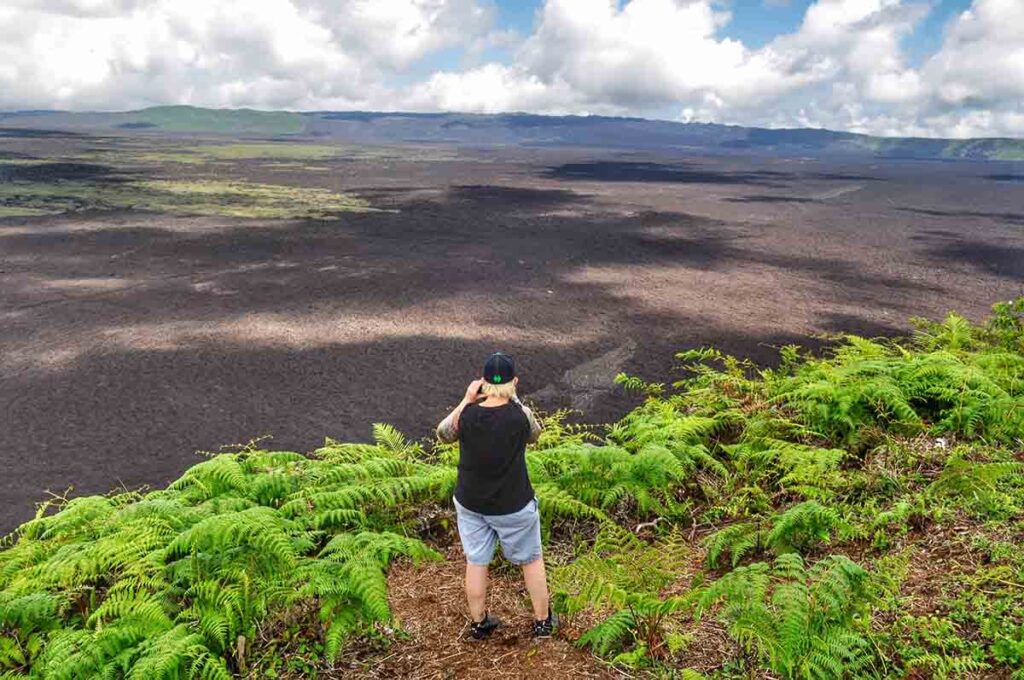
Sierra Negra’s caldera deserves a specific note because the number is genuinely striking: 10 km wide by 9 km — the second-largest volcanic caldera on Earth. It last erupted in 2018, and the evidence is visible on the rim trail: fresh basalt flows, heat-cracked rock, terrain that looks recently disturbed because it was. This is not ancient geology on display. The caldera rim at Sierra Negra stops you mid-step — not because it’s beautiful (though it is), but because the scale refuses to compress into the frame of a normal landscape.

On the west coast, two oceanographic forces produce conditions found nowhere else in the archipelago. The Cromwell Current — a deep-water equatorial current — upwells along Isabela’s west coast, dragging cold, nutrient-dense water to the surface. This feeding ground supports marine life at concentrations unusual even for the Galápagos. The Bolívar Channel, the narrow strait between Isabela and Fernandina, holds the coldest waters in the archipelago — and some of its most productive wildlife habitat.

One practical note: this is a volcanically active island. The Galápagos National Park Service (GNPS) monitors eruption status and can close visitor sites without advance notice. While all Isabela volcanoes are currently stable and open under standard Green/Normal alert levels, travelers planning the Sierra Negra hike or west coast cruise sites should check current conditions with their operator before departure.

Visitor Sites

Land-Based

The following sites are accessible from Puerto Villamil without a multi-day cruise. They cover genuine ecological diversity — this is not a consolation itinerary. But there are specific species and locations that genuinely cannot be reached without cruise access, and that gap is noted honestly where relevant.

Las TintorerasLand-based

Las Tintoreras

A short panga (dinghy) ride from Puerto Villamil — typically 15–20 minutes. The main draw is a narrow lava channel where whitetip reef sharks rest in the shallows, stacked along the bottom in a formation that looks almost staged. Marine iguanas bask on the surrounding lava. Galápagos penguins are present during the cold season (June–November) — reliably so in those months, hit or miss otherwise. What you might miss: this is not a replacement for the west coast cormorant and penguin concentrations. The cold-season penguin sightings here are genuine, but the west coast sites are a different order of magnitude.

Galapagos Penguin →
Concha de PerlaLand-based

Concha de Perla

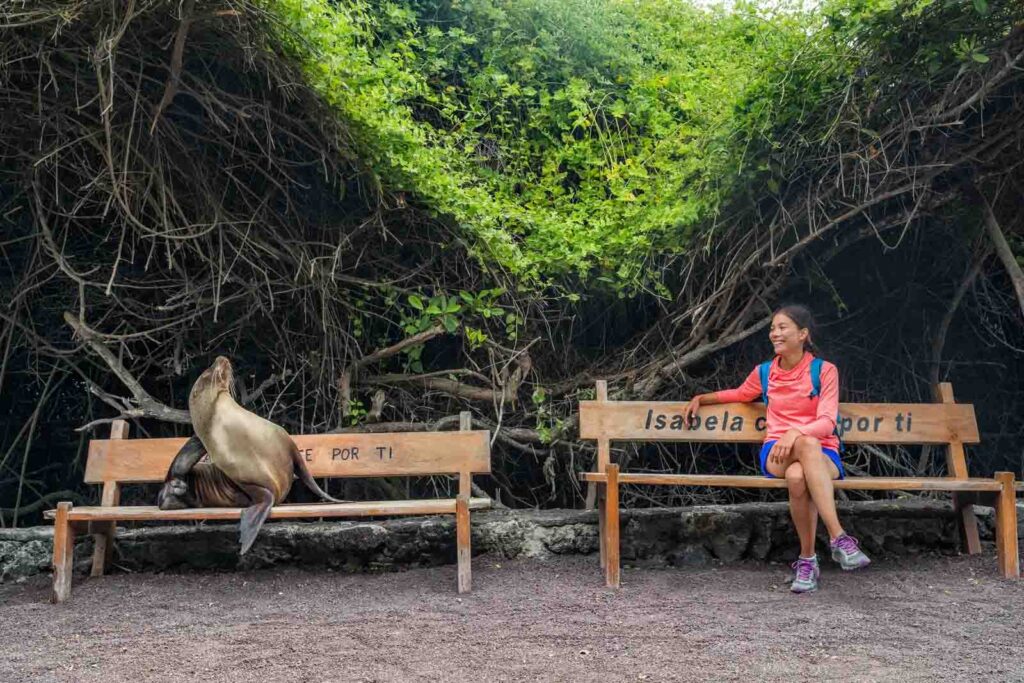
A free snorkeling site accessible by a short walk and a dock at the edge of Puerto Villamil. No fee, no permit required beyond the standard park entrance. Sea lions are present in the water and on the rocks — relaxed, uninterested in tourists, occasionally curious. Fish variety is good. What you might miss: this site lacks the dramatic oceanographic richness of the west coast snorkeling sites (Elizabeth Bay, Punta Vicente Roca), but as a complimentary morning activity it is hard to beat in terms of accessibility.

Arnaldo Tupiza Tortoise Breeding CenterLand-based

Arnaldo Tupiza Tortoise Breeding Center

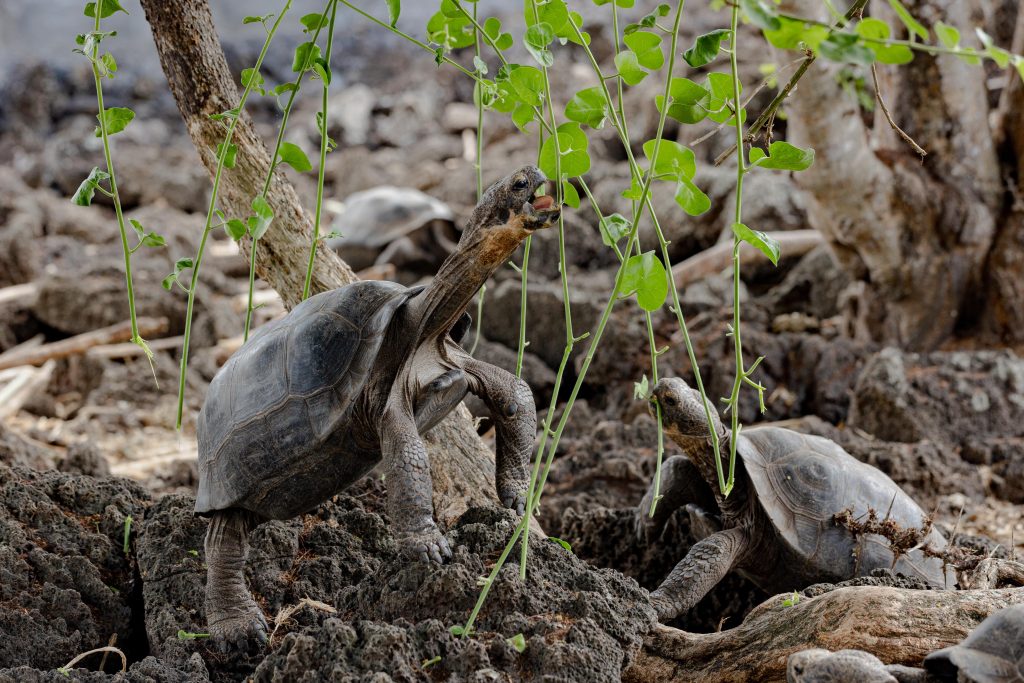
The primary tortoise conservation facility on Isabela, holding approximately 1,000 tortoises across six subspecies — one per volcano. The signage is specific about which tortoises come from which volcano, which means a slow visit produces an actual education in Isabela’s biological structure rather than a general tortoise experience. Walk time: 45–60 minutes at a relaxed pace. Located within walking distance of central Puerto Villamil. Best visited in the morning before midday heat.

Giant Tortoise →
The Wetlands and Flamingo LagoonLand-based

The Wetlands and Flamingo Lagoon

A boardwalk trail through mangroves and coastal lagoons on the edge of Puerto Villamil. Flamingos are reliably present in the lagoons — not in the hundreds, but in numbers sufficient to photograph without a telephoto lens. Common stilts, white-cheeked pintails, gallinules, and whimbrels share the same area. Total boardwalk distance: approximately 2–3 km one way, depending on which sections are walked. Morning light is best for photographs. No admission fee beyond the park entrance.

Wall of Tears (Muro de las Lagrimas)Land-based

Wall of Tears (Muro de las Lagrimas)

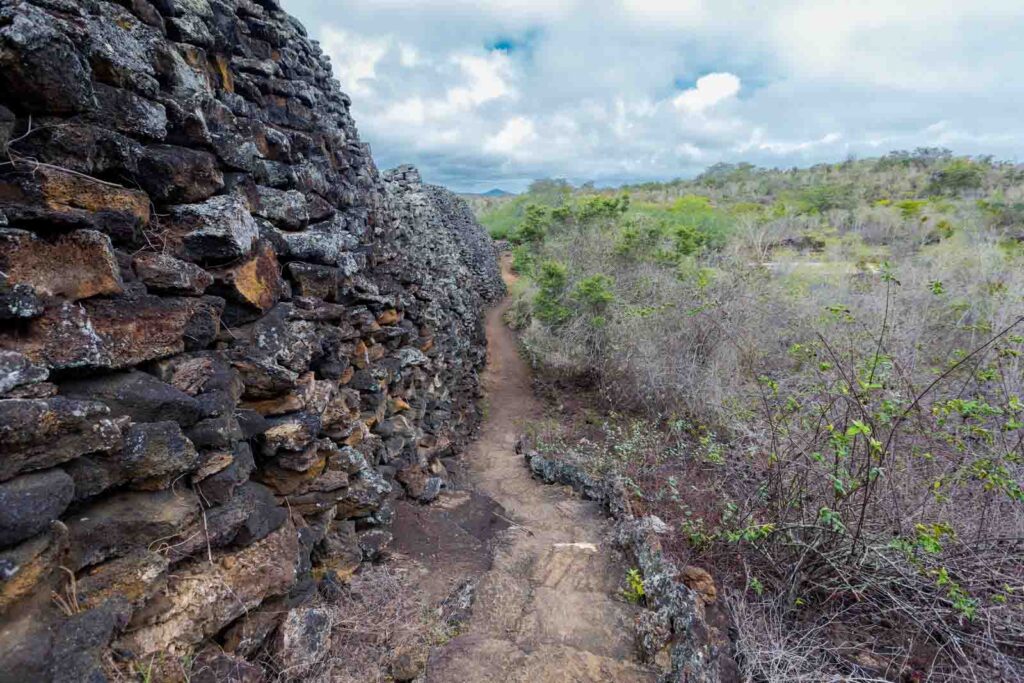
A lava-block wall constructed by prisoners of the Isabela Island penal colony between 1946 and 1959. The wall serves no structural purpose — it was built and rebuilt as a punishment task, and the name reflects the conditions under which it was built. Distance from Puerto Villamil: approximately 5 km one way, accessible by bicycle, horse, or on foot along a sandy track. The site itself takes 15–20 minutes to visit; the journey through the arid landscape is the majority of the experience. Combine with the nearby flamingo lagoon at Pozo Verde and the viewpoint above the wall for a half-day circuit.

Sierra Negra Volcano HikeLand-based

Sierra Negra Volcano Hike

The most physically demanding and rewarding land-based site on Isabela. The trailhead is a 45-minute drive from Puerto Villamil (4WD required). The hike itself is 15 km round trip, gaining elevation through cloud forest before reaching the rim of the second-largest volcanic caldera on Earth. The 2018 eruption left fresh basalt flows visible on and beyond the caldera rim — the terrain near the Chico Volcano viewpoint shows active fumarolic activity. Seven finch species are regularly encountered on the trail. Galápagos hawks appear near the rim. Duration: most guided groups complete the round trip in 5–7 hours. A licensed naturalist guide is required for all national park visits. This hike is non-trivial. The altitude, variable weather, and uneven lava terrain mean it is not suitable for visitors with limited mobility. Bring extra water — the highland climate is cooler but deceptively dehydrating.

Best Time To Visit →

Cruise-Only

These six sites account for much of what makes Isabela Island a priority destination for serious wildlife travelers — and all of them require a cruise itinerary that specifically includes the west side of Isabela. Not every cruise does. When researching itineraries, check explicitly whether Tagus Cove, Punta Albemarle, Elizabeth Bay, Punta Vicente Roca, Urbina Bay, and Moreno Point are included. Cruises Seaman Journey

Tagus CoveCruise-only

Tagus Cove

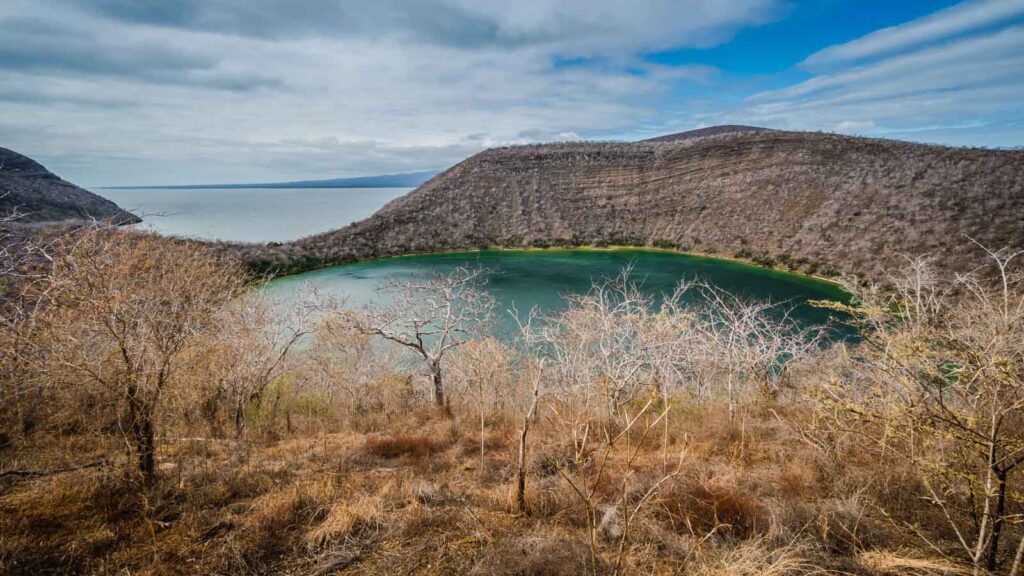
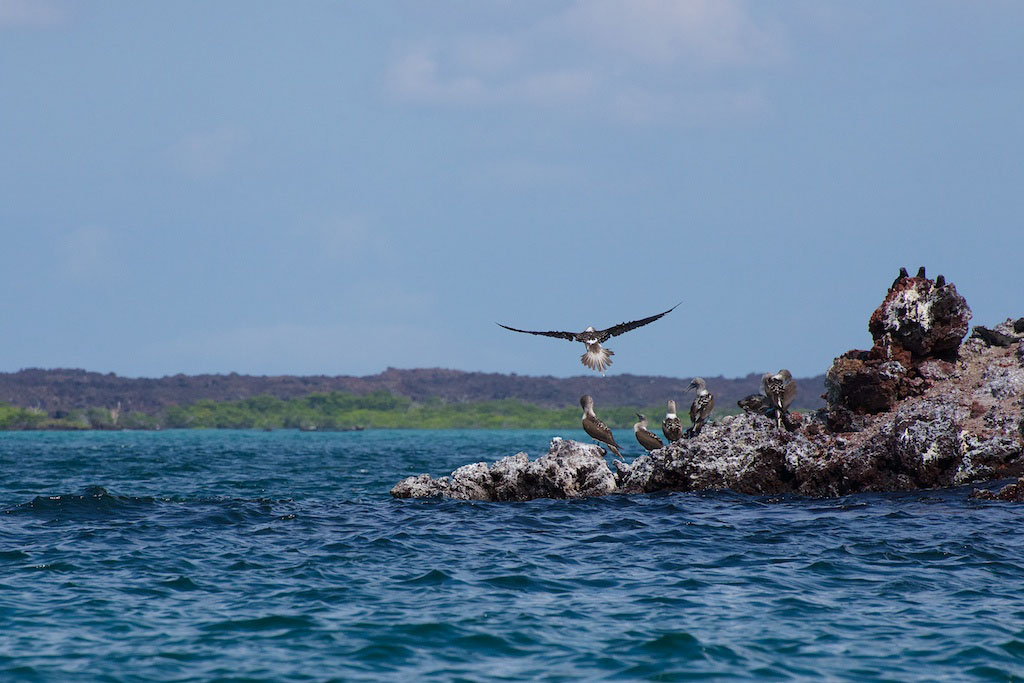
One of the most historically significant anchorages in the Galápagos — whalers, pirates, and early naturalists all used this sheltered cove. Charles Darwin anchored here in 1835. The walls of the cove are marked with the names and dates of visiting ships, some dating back two centuries. Wildlife at Tagus Cove is equally dense: blue-footed boobies nest on the slopes above the water; flightless cormorants fish from the rocky shoreline; Galápagos penguins are present year-round; Galápagos hawks patrol the higher ground; Darwin finches and yellow warblers work the vegetation. Darwin Lake — a saltwater crater lake above sea level, reached by a trail from the cove — adds a striking geological feature to an already rich site. A panga ride along the cliff base is standard on most cruise visits here.

Flightless Cormorant →
Urbina BayCruise-only

Urbina Bay

Urbina Bay underwent a major geological uplift event in 1954, when the seafloor around it rose by up to six meters in a matter of hours. The evidence is still visible: bleached coral heads sitting well above the waterline, stranded far from the sea. Land iguanas here are exceptionally large — vivid yellow, noticeably heavier than their Santa Cruz counterparts. Sea turtles nest on the beach at Urbina, and the nesting habitat is undisturbed by human infrastructure in the way that beaches near inhabited islands are not. The combination of dramatic geology, large reptiles, and nesting sea turtles makes Urbina Bay a site that holds attention even for experienced Galápagos travelers.

Elizabeth BayCruise-only

Elizabeth Bay

A shallow bay on Isabela’s west coast reached by panga ride through mangrove channels. The approach through the mangroves is itself the experience: Galápagos penguins perch on mangrove roots at eye level; sea turtles surface regularly; rays sweep across the sandy floor. The closed, sheltered geometry of the bay concentrates wildlife in ways that open-water sites do not. Elizabeth Bay is primarily a panga and snorkel site — there is no land visitor trail. Visits are conducted from the water.

Galapagos Penguin →
Punta Vicente RocaCruise-only

Punta Vicente Roca

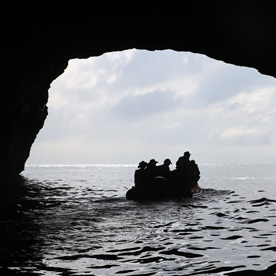
The collapsed remnant of Ecuador Volcano — the northernmost point of Isabela — forms a dramatic cliff face with sea caves accessible by panga. This is widely considered one of the best dive and snorkel sites in the entire Galápagos. The cold Cromwell Current upwelling is directly felt here: the water is cold, visibility varies, and the species mix reflects a deep-water feeding ground rather than a tropical reef. Ocean sunfish (Mola mola) are reliably encountered — often in multiples, at close range. Galápagos sharks patrol the deeper water. Seahorses are present in the kelp along the cliff base. The combination of dramatic surface geology and extraordinary underwater life makes this a site travelers consistently rank among their most memorable.

Galapagos Whale Watching →
Punta AlbemarleCruise-only

Punta Albemarle

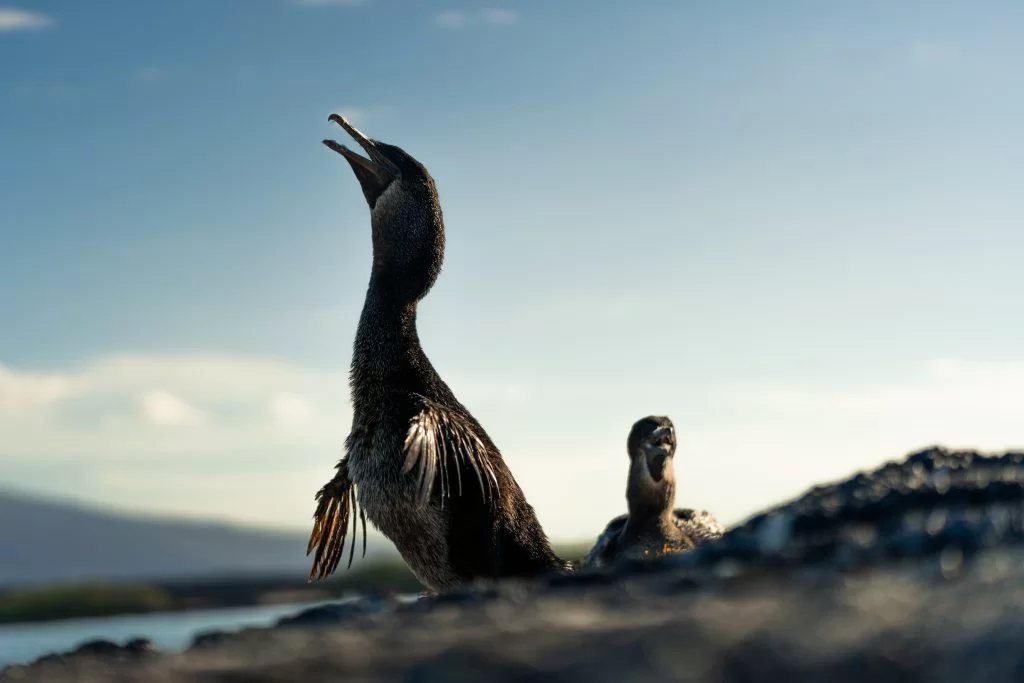
The northernmost visitor site on Isabela, accessible only by sea. Flightless cormorants nest here — this is one of the primary nesting sites for the species in the archipelago. The marine iguanas at Punta Albemarle are among the largest in the Galápagos, consistent with the pattern of Isabela’s west coast producing outsized specimens due to the nutrient richness of the Cromwell upwelling. A panga ride along the cliffs is the standard approach.

Flightless Cormorant →
Moreno PointCruise-only

Moreno Point

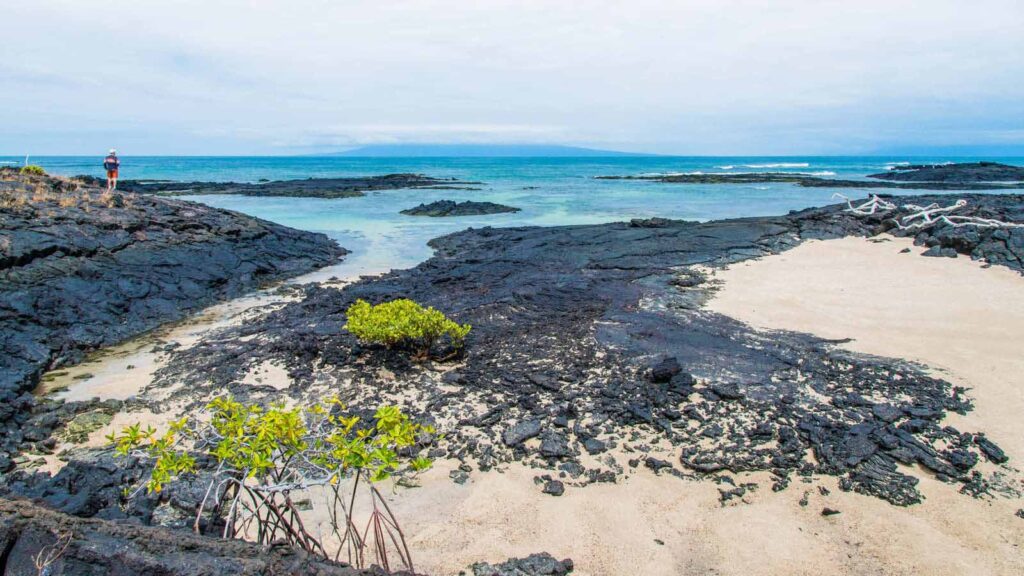
Tidal pools at Moreno Point hold a concentrated cross-section of Isabela’s coastal wildlife: sea turtles, rays, white-tipped reef sharks, and marine iguanas in the immediate shallows. Flamingos appear in the inland lagoons near the point — a combination of coastal and wetland species in a single short walk that is unusual even by Galápagos standards. The terrain is raw volcanic lava, and the walking surface is uneven. Solid footwear is not optional.

Getting to Isabela

There are two ways to reach Puerto Villamil: by boat from Santa Cruz, or by small aircraft. Neither is direct from the mainland. All travelers to the Galápagos transit through Quito or Guayaquil first, then fly to Baltra or San Cristóbal.

By Speedboat from Santa Cruz

The speedboat crossing from Puerto Ayora (Santa Cruz) to Puerto Villamil runs approximately 2.5 hours. Multiple departures are typically available daily in each direction — early morning departures are standard. The crossing is on the open ocean and can be rough depending on season; the cold-season swells (June–November) are more pronounced than in the warm season.

By Small Aircraft

Small aircraft connect Puerto Villamil (Isabela) with Baltra and San Cristóbal. EMETEBE Airlines and Fly Galapagos are the primary operators on these routes, though operator availability and frequency should be confirmed at the time of booking. Flights are short (under 45 minutes), and seat availability is limited — book well in advance.

Cruise travelers arriving directly to Isabela do so by vessel — their cruise ship will anchor offshore and transfer guests by panga. Port logistics are managed by the cruise operator.

Galapagos Entry Requirements Permits →

When to Visit

Best Time to Visit

The Galápagos has two broad seasons, and Isabela’s wildlife distribution shifts meaningfully between them.

Neither season is objectively better for Isabela as a whole — the wildlife calendar simply shifts. If the flightless cormorant and west coast whale-watching are the primary objectives, June through October is the peak window. If the tortoise breeding center and calmer seas are priorities, December through April works well.

Best Time To Visit →See the seasonal wildlife calendar ↓

Where to Stay

Accommodation in Puerto Villamil

Puerto Villamil has no large resort infrastructure. Accommodation is primarily small hotels, guesthouses, and B&B-style properties — most within walking distance of the beach, the wetlands boardwalk, and the departure point for Las Tintoreras. The town has a main street with restaurants, beach bars, and a small church decorated with marine motifs. The pace is unhurried in a way that Santa Cruz no longer is.

Wildlife — What Lives Here and Where

Isabela’s wildlife divides cleanly into two categories: what you can access from Puerto Villamil on a land-based trip, and what requires a multi-day cruise to the west coast. That distinction matters enormously — not in terms of which is better, but in terms of which species are only accessible one way.

Land-Accessible Wildlife

The Arnaldo Tupiza Tortoise Breeding Center holds approximately 1,000 tortoises representing six distinct subspecies — one per volcano. This matters more than it sounds. Giant tortoises in the wild on Isabela are not a single uniform population; each volcano’s subspecies evolved independently in isolation, with distinct shell morphology and size. The breeding center’s signage explains this by volcano, making it the best single location to understand Isabela’s unusual biological structure. Giant Tortoise

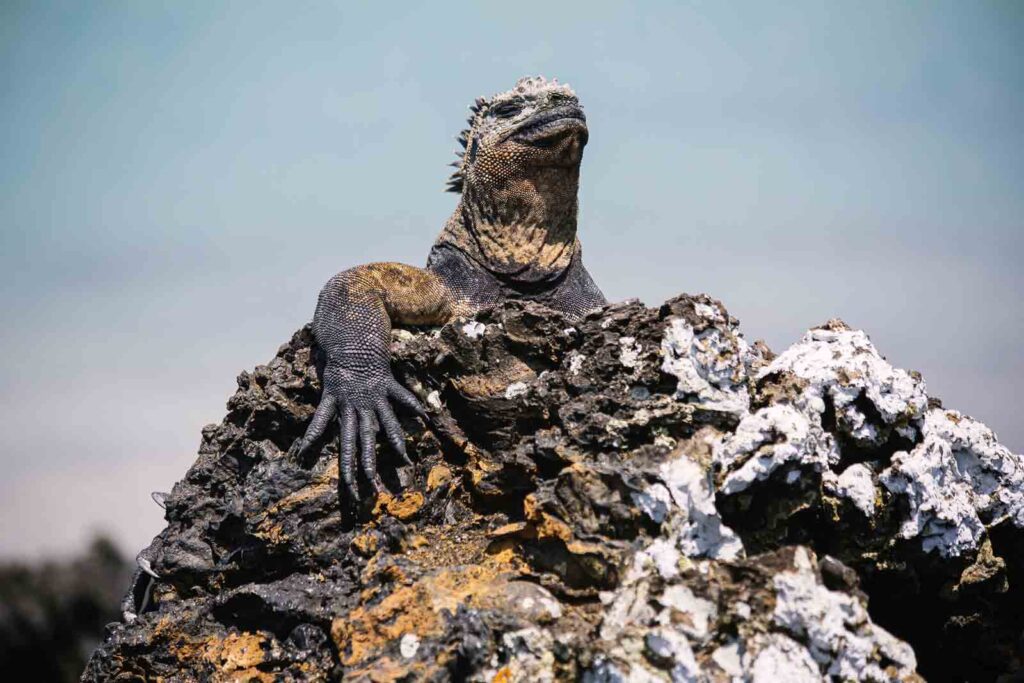
Marine iguanas on Isabela are the largest subspecies found anywhere in the Galápagos. Males in the Las Tintoreras area can reach significant size — large enough that their basking congregations look more like a geological feature than an animal assembly. Marine Iguana

Flamingos are present in the wetland lagoons near Puerto Villamil, within the wetlands complex that runs along the shoreline. Common stilts, whimbrels, white-cheeked pintails, and gallinules also frequent the boardwalk area — the kind of shorebird variety that quietly rewards a slow hour on the path.

Galápagos penguins can be seen at Las Tintoreras — but seasonally. Cold-season visits (June through November) produce the most reliable penguin sightings there. Warm-season visits (December through May) are likely to be penguin-light at Las Tintoreras, though sea lions remain year-round. Galapagos Penguin

Phalacrocorax harrisi

West Coast (Cruise-Only) Wildlife

Phalacrocorax harrisi

The flightless cormorant (Phalacrocorax harrisi) exists nowhere on Earth except the west coast of Isabela and on Fernandina — and reaching either location requires a multi-day cruise. There are approximately 1,000 breeding pairs total. This is not a rare bird in a technical sense; it is a highly localized one, concentrated at a handful of nesting sites. Tagus Cove and Punta Albemarle are the primary access points. No day tour from Puerto Villamil reaches these. Flightless Cormorant Fernandina

The Galápagos Conservancy has identified 16 species of whales in the waters off Isabela’s west coast, including humpbacks, sperm whales, sei whales, minkes, and orcas. Whale-watching is most productive on the west coast cruise circuit — the Cromwell Current upwelling creates the feeding conditions that attract large cetaceans in numbers unusual for equatorial waters. Galapagos Whale Watching

Punta Vicente Roca, the collapsed remnant of Ecuador Volcano, sits at the island’s northern tip and is consistently ranked among the best dive and snorkel sites in the archipelago. Ocean sunfish (Mola mola) are a specific draw — these massive animals, some exceeding 2 meters in length, are regularly encountered here in concentrations unusual elsewhere. Galápagos sharks, seahorses, and cold-water species pushed up by the Cromwell Current are regular sightings.

At Urbina Bay, land iguanas grow to a size and coloration — vivid yellow, substantially larger than their counterparts elsewhere — that makes them visually distinct from land iguanas on other islands. Sea turtles nest on the beach at Urbina Bay, and the geological uplift visible in the terrain tells a coherent story about recent volcanic activity.

Galápagos hawks appear on the rim trail of Sierra Negra (accessible from Puerto Villamil by 4WD and on foot) and around Tagus Cove (cruise-only). The Sierra Negra trail also yields seven finch species — a concentration that makes the hike worthwhile for birders even beyond the caldera itself.

Wildlife Calendar

June – November

Cold / Dry Season

Cooler air and water temperatures; stronger Humboldt Current influence; choppier seas on west coast crossings Galápagos penguins at Las Tintoreras; best whale-watching on west coast; large marine iguana aggregations; snorkeling with sea lions; Sierra Negra hike (drier underfoot)

December – May

Warm / Wet Season

Warmer waters; calmer seas; occasional rain showers (short); sea surface temperature rises Tortoise nesting activity; sea turtle nesting at Urbina Bay; calmer west coast seas for snorkeling; blue-footed booby courtship displays

Plan Your Visit

Isabela can be visited land-based, as part of a cruise, or both. The right channel depends on how you are traveling and whether you are booking directly or working through a travel professional.

Direct travelers

Book with Voyagers Travel Company

Voyagers Travel Company matches independent travelers to the right Isabela itinerary — land-based stays in Puerto Villamil, cruises that include west coast sites, or combined trips. Current vessel availability, honest itinerary advice, and no generic aggregator markup.

Contact Voyagers Travel Company →
Travel trade

Latin Trails (DMC Partner)

Latin Trails is a licensed Galápagos destination management company offering net rates, group allocations, and private charter options for tour operators and wholesalers. Industry inquiries, FIT packages, and trade pricing through the DMC channel.

Contact Latin Trails →

Frequently Asked Questions

Is Isabela Island worth visiting on a land-based trip?

Yes — with an honest qualification. The Arnaldo Tupiza Tortoise Breeding Center, the Sierra Negra volcano hike, Las Tintoreras, and the wetlands complex are all genuine wildlife experiences that stand on their own merits. Two to three days in Puerto Villamil is not a wasted trip. What a land-based visit cannot provide is access to the west coast: no flightless cormorants in the wild, no whale-watching in the Cromwell upwelling, no Punta Vicente Roca, no Tagus Cove. For travelers with specific wildlife objectives that include those species and sites, a cruise itinerary covering west Isabela is the only solution.

How do I get to Isabela Island from Santa Cruz?

By speedboat from Puerto Ayora to Puerto Villamil — approximately 2.5 hours on the open ocean. Multiple departures are typically available each morning. The crossing can be rough during the cold season (June–November). Small aircraft from Baltra or San Cristóbal offer an alternative — shorter journey, but limited seats and less frequent schedules. Book both modes in advance during peak season.

Can I see flightless cormorants from Puerto Villamil?

No. Flightless cormorants nest exclusively on the west coast of Isabela (Punta Albemarle, Tagus Cove) and on Fernandina — both reachable only by multi-day cruise. There are approximately 1,000 breeding pairs of this species on Earth. All of them live in locations that require overnight cruise access. No day tour, water taxi, or charter from Puerto Villamil reaches these sites. This is a GNPS regulatory boundary, not a logistical workaround.

How long should I spend on Isabela?

For a land-based visit: two to three days covers Las Tintoreras, the tortoise breeding center, the wetlands, and the Sierra Negra hike comfortably — three days if you want time to do the volcano hike properly and not rush. For a cruise that includes west Isabela: most itineraries allocate two to three days to west coast sites (Tagus Cove, Urbina Bay, Elizabeth Bay, Punta Vicente Roca, Punta Albemarle). A combined trip — arriving by boat from Santa Cruz, spending time in Puerto Villamil, then continuing by cruise — is logistically possible and covers both access modes.

What makes Isabela different from other Galápagos islands?

Scale and geological activity, primarily. At 4,670 km², Isabela is larger than every other Galápagos island combined — the scale of the caldera at Sierra Negra, the distance between the northern and southern volcanoes, the breadth of the west coast are all in a different register from other islands. The six-volcano structure means six distinct giant tortoise subspecies on a single island — something no other island replicates. The Cromwell Current upwelling produces wildlife concentrations (16 identified whale species, Mola mola, flightless cormorants) that are specific to this west coast oceanographic system. Isabela is not simply a larger version of Santa Cruz. It is ecologically distinct.